AI news, November 12, 2026: Grok Bot 1.0, open Grok Build apps, Qwen4-Max-Preview, Claude Whiteboards
Short answer: The main stories of November 10 to 12: Grok Bot 1.0 was announced for teams in Slack, Teams and meetings, Claroc researchers found 35,578 apps built with Grok Build that are open without a login, Alibaba shows Qwen4-Max-Preview with an end date of November 25, Gemini 4 Carbon costs 2/10 dollars per million tokens until November 30 and Claude gets Whiteboards, Sheets and Data. The Inkling 2 Small weights and a GPT-6.2 announcement are still missing.
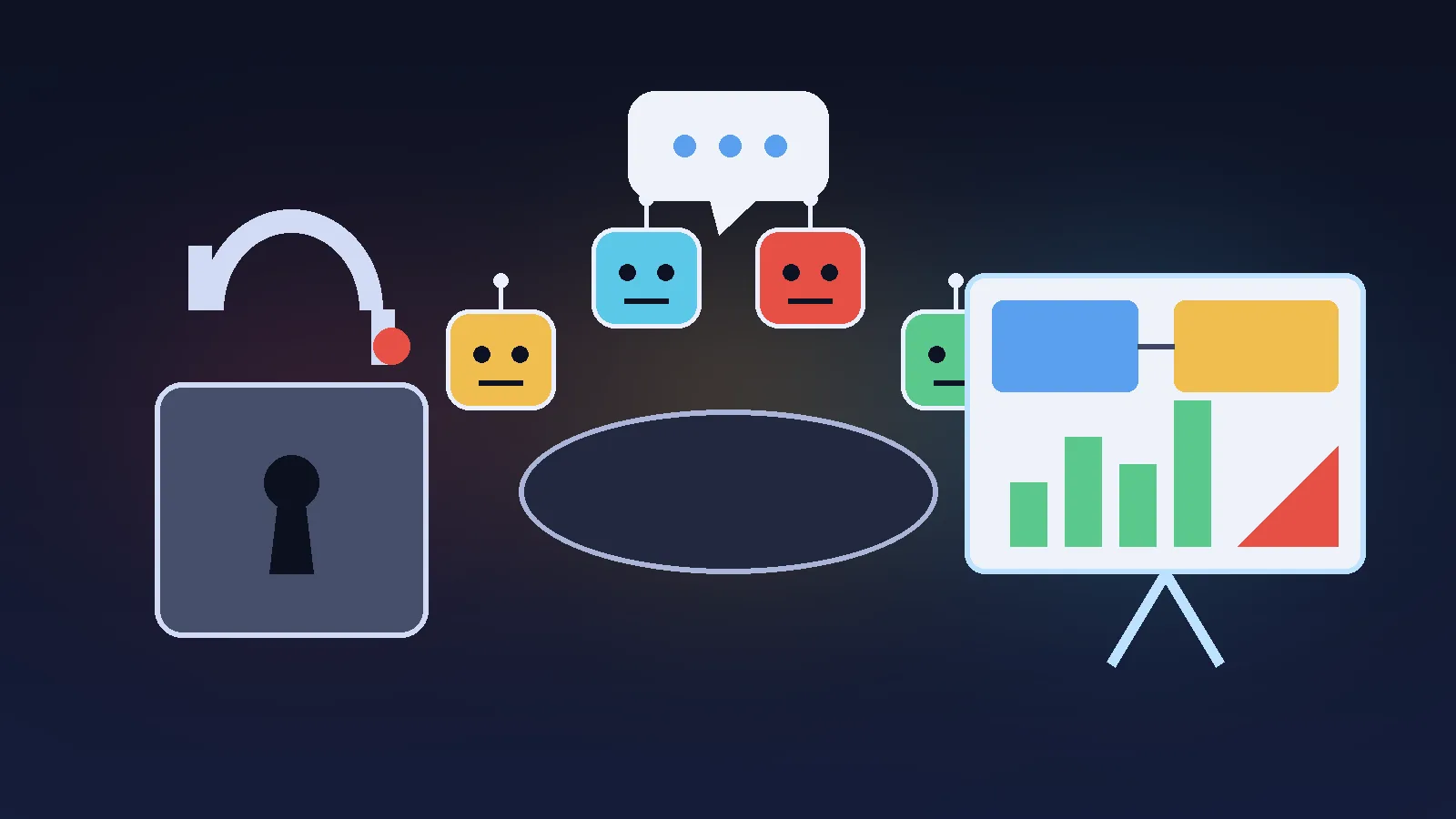
Illustration by Claude (AI), drawn with code: an open padlock (open Grok Build apps), a table with bots (Grok Bot 1.0) and a whiteboard (Claude Whiteboards).
Grok Bot 1.0 announced: shared bots for Slack, Teams and meetingsConfidence: medium: announcement and replies read on X in the search round; the xAI product page for 1.0 was not read back
On November 11 @bot, the official Grok Bot account, posted: 'Introducing Grok Bot 1.0. AI teammates that work alongside your whole team.' According to the post, teams can share bots, work with bots in Slack and Teams, and invite bots to meetings. According to our search round of November 12 at 07:30 the post had about 45 million views; @elonmusk replied 'Try Grok @Bot'.
Databricks announced Genie plugins for ChatGPT, Claude, Copilot Cowork and Grok Bot. @jasonfried reports that Basecamp's hosted MCP server works with ChatGPT, Claude, Grok, Grok Bot and Muse, among others. Prices, limits and availability per region were not read back on an xAI page.
What this means: a bot in a shared workspace gets access to the channels and files of the whole team. First check which permissions the bot gets and who can read the conversations back. That Databricks and Basecamp now name Grok Bot next to ChatGPT and Claude shows that companies build their integrations for all major agents at once.
Sources: @bot op X (Grok Bot 1.0) · @elonmusk op X · @databricks op X (Genie-plugins) · @jasonfried op X (Basecamp MCP)
Grok Build: researchers find 35,578 apps that are open without a loginConfidence: high for Claroc's figures and dates (page read by Grok Bot); medium for SpaceXSI's response, known only through Claroc; no official xAI response found
On November 10 Claroc Research published a report on apps built and shared with Grok Build. Of 43,551 addresses tried, 37,571 were still online; 35,578 of those (94.7 percent) opened without a login. According to Claroc this includes 24 apps from SpaceXSI and X employees, among them a confidential onboarding plan and a sales map of 594 accounts. Claroc writes that 'Anyone with the link' was suggested as the publishing setting in the account they used.
Claroc reported this on November 8 and 9 to SpaceXSI. According to the report SpaceXSI took the 24 staff apps offline, but not the apps of other users; SpaceXSI tells Claroc that employee apps start out private. In the search round of November 10 and 11 Grok Bot found no official post from @xai or @elonmusk. Posts from the @grok account are chatbot summaries and not a security advisory.
What this means: anyone who published something with Grok Build should check the sharing setting of those apps. A link that anyone can open is not a secret, even if the hostname looks hard to guess. Do not install 'fixes' from third parties. Background on such risks is in our overview of AI and cybersecurity.
Sources: Claroc Research: Grok Build apps · Ars Technica over Grok Build · @IntCyberDigest op X
Qwen4-Max-Preview disappears after November 25; Gemini 4 Carbon costs half until November 30Confidence: high for dates, context and prices (pages read by Grok Bot); medium for the WANDR score, a claim by Perplexity itself
Alibaba Cloud describes Qwen4-Max-Preview (model id qwen4-max-preview) on a page updated on November 11. The model has 1 million tokens of context and is only available through a Token Plan, not pay-as-you-go. The preview runs from November 11 10:00 to November 25 24:00 (UTC+8); after that the model is taken out of service. Maximum output is 393,216 tokens, shared by thinking and the answer. The page lists no benchmark, no token price and no open weights.
On its model page Google calls Gemini 4 Carbon its most capable reasoning model, with 1,048,576 tokens of context. The price is 2 dollars per million input tokens and 10 dollars per million output tokens until November 30, 2026, then 4 and 20 dollars. According to @testingcatalog Google AI Studio requires a Google AI Ultra plan or an API key for the model. Perplexity reports 0.857 on its own WANDR benchmark, in its words on par with Fable 5.2 at 40 percent of the cost; that is a company claim.
What this means: Qwen4-Max-Preview is a trial with an end date and does not belong in a route that must keep running after November 25. For agent loops, watch the shared output budget, since thinking can cut off the answer. Until November 30 Carbon costs half of Fable 5.2 on output price (40 dollars); afterwards it stays cheaper. Background on such agent sessions is in our overview of agentic AI.
Sources: Alibaba Cloud: Qwen4-Max-Preview · Google: Gemini 4 Carbon · Google: Gemini API-prijzen · @perplexity_ai op X · @testingcatalog op X
Claude gets Whiteboards, Sheets and Data; ChatGPT Business works in Hermes and OpenClaw; OpenClaw 2026.11.3Confidence: high for the OpenClaw release (GitHub read by Grok Bot); medium for the announcements on X, whose product limits were not read back
On November 10 @claudeai announced Claude Whiteboards, Claude Sheets and Claude Data (more than 7.8 million views according to the 07:30 run). @AInieuwsNL reports that it is a beta in every paid plan; those plan and region limits were not read back on an Anthropic page. @AnthropicAI also reports the start of the roadshow for the planned IPO.
@OpenAIDevs reports that a ChatGPT Business subscription now works through 'Sign in with ChatGPT' in tools including Hermes Agent and OpenClaw; @NousResearch confirms the flow for Hermes. The OAuth scopes were not checked against OpenAI's documentation. According to the release notes OpenClaw v2026.11.3 (November 10) keeps subagent results out of the chat, no longer turns unanswered tool errors into successes and stops authentication at the run deadline. The tag v2026.9.37 is an older September line and not an upgrade.
What this means: the labs are building work surfaces next to the chat, and subscriptions become the access layer for open agent harnesses. Anyone who puts Hermes or OpenClaw on a subscription no longer sees costs per token. For OpenClaw it pays to read the release notes before updating. Background is in our overview of MCP servers and agent tooling.
Sources: @claudeai op X (Whiteboards, Sheets, Data) · @AnthropicAI op X (roadshow) · @OpenAIDevs op X (Sign in with ChatGPT) · @NousResearch op X · OpenClaw v2026.11.3 op GitHub
Perplexity tests its agent sandbox with 12 models; a benchmark puts the harness above the modelConfidence: low to medium: both results come from posts on X; the research pages were not read back
On November 11 @perplexity_ai reported new research on red-teaming SPACE, the VM sandbox for Computer agents. According to the post, 12 models were given two tasks: break out of the VM to take a credential from the host, and bypass the network policy to reach a blocked target. Perplexity draws two lessons: the usual Capture the Flag setup can steer agents away from the boundary being tested, and security-specialised models do not necessarily do better. The research page itself was not read back; the post is the only source.
A second study was widely shared on X (@AnnatarXBT, about work by Joel Niklaus). Nine coding harnesses ran in 28,849 runs with a fixed model, a fixed provider and a fixed reasoning effort. According to the post, mini-swe-agent scored 51.4 percent and Pi 49.4 percent at 0.29 dollars per solved task, against 27.3 percent for OpenClaw; OpenCode cost 3.35 dollars per solved task. These figures come from the post and were not recomputed.
What this means: test a sandbox with a setup that fits your own risks and not only with a standard CTF. With the model held fixed, the harness scores in this measurement differed widely; compare on your own tasks before switching harness. Neither result has been confirmed by a second source yet.
Sources: @perplexity_ai op X (SPACE red-teaming) · @AnnatarXBT op X (harness-benchmark)
Inkling 2 Small: no weights yet on November 11; GPT-6.2 not announcedConfidence: high for the missing repository and the license text (pages and API read by Grok Bot); low for GPT-6.2, established only as an absence in a search round
On November 5 Thinking Machines wrote that the weights of Inkling 2 Small would follow under Apache 2.0 'next week', after external safety testing. On November 11 that sentence is still there, without a date and without a repository on Hugging Face. The only Inkling card on the Hub is an unofficial one from November 5. GPT-6.2 got no announcement from OpenAI on November 11 either and remains a rumor; @kimmonismus expects it for Thursday, November 12, also without confirmation from OpenAI.
For open weights too, the date on the source counts. MiniMax-H3-Image was reported as 'just released', but the repository dates from November 3; the license carries the date November 10 and excludes the European Union, the United Kingdom, Korea and the United States. NVIDIA's Alpamayo 2 Edge (repository from August 12) and the ERNIE 5.5 Flash base (October 21) are not new from last night either.
What this means: only add Inkling 2 Small to a route once the repository exists. For every 'new' open model, check the repository's createdAt and the license text, especially for use in the Netherlands.
Sources: Thinking Machines: Inkling 2 Small · MiniMax-H3-Image op Hugging Face · MiniMax-H3-Image licentie · NVIDIA Alpamayo2-Edge op Hugging Face
Primary sources: Claroc Research: Grok Build apps · Alibaba Cloud: Qwen4-Max-Preview · Google: Gemini 4 Carbon