AI news, November 17, 2026: Grok Bot 1.0, OpenAI outside evaluation, Perplexity Frontier Research, agent security
Short answer: The main stories of November 16 to 17: Grok Bot 1.0 brings team bots and a larger routine budget, OpenAI gives outside evaluators deep access and opens free access for scientists while California files a lawsuit, Perplexity puts 10,000 GPUs behind Frontier Research and OpenClaw reports 95.5 percent lower estimated CI costs. Claims about VirusTotal in Claude and an NVIDIA plugin for Hermes are unconfirmed.
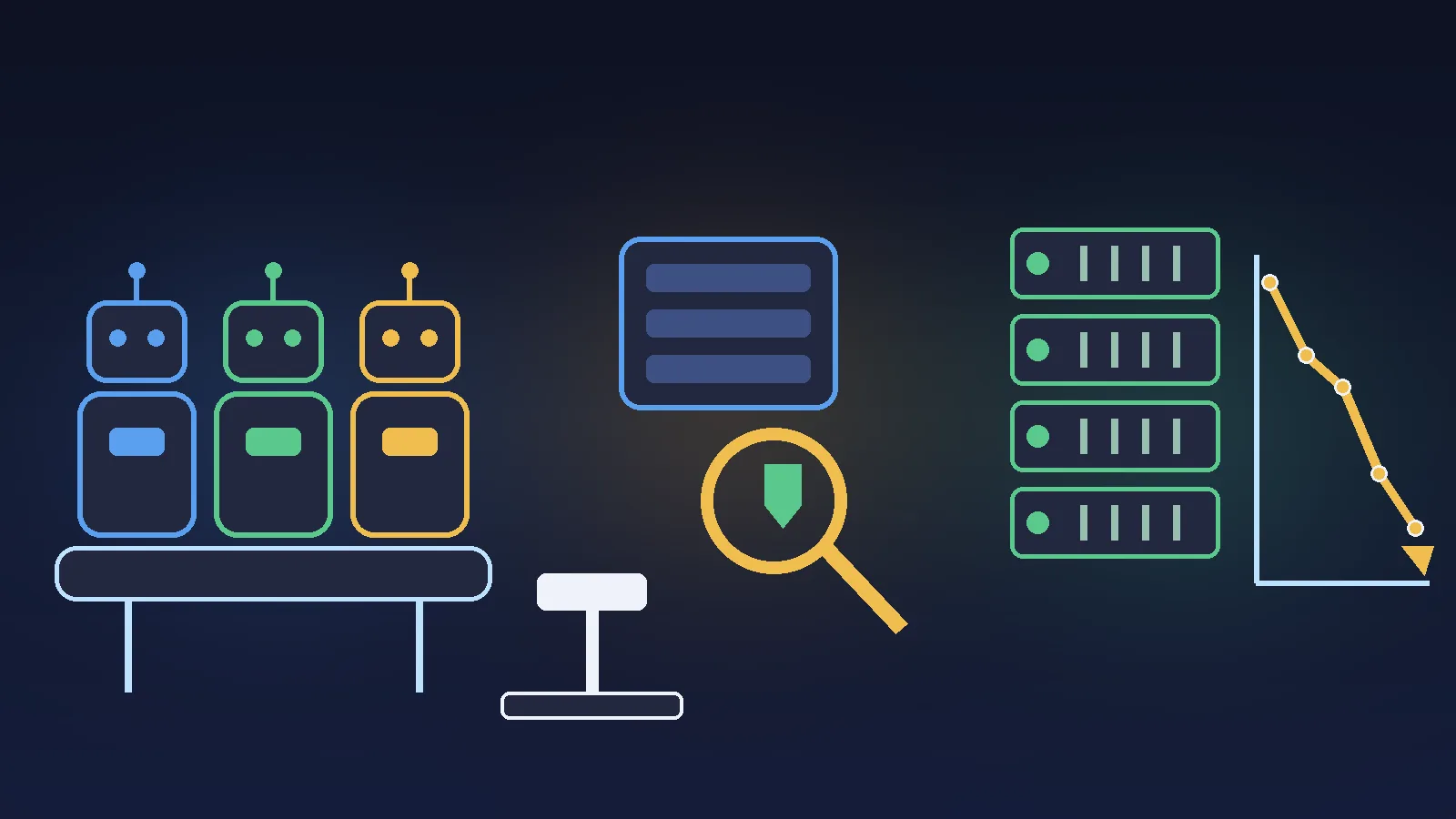
Illustration by Claude (AI), drawn with code: bots at a meeting table (Grok Bot), a magnifier with shield and gavel (OpenAI), a GPU rack with a falling cost line (Perplexity and CI costs).
Grok Bot 1.0: team bots, bots in meetings and a larger routine budgetConfidence: medium: the features come from posts by users with reach; no official release page was read; the percentages are the poster's figures.
On X, @mattyp and @benln lay out what Grok Bot 1.0 brings. @mattyp lists a Team Bot, bots that join meetings, bots that take initiative and bots that learn from earlier tasks (745 thousand views). @benln lists what shipped over the past days: roughly 7 percent more usage per plan, up to roughly 15 percent more for routines, a Tailscale integration, phone calls and access to Messages, Mail and Contacts on the Mac (165 thousand views). Elon Musk also quoted a user whose bot spent ninety minutes on a call with AT&T, said to be the call time limit.
What this means: the new features turn a bot into a participant in team work, with more access to the user's computer. Anyone who gives bots access to mail, contacts and messages should limit the permissions per bot. Another user reports that more and more web shops, airlines and banks block or restrict personal agents; that is his own inventory. Background on software that works on its own is in our overview of agentic AI.
Sources: @mattyp over Grok Bot 1.0 op X · @benln over recente Grok Bot-releases op X · Quote van Elon Musk over een belgesprek van 90 minuten op X · @thejakebuzz over blokkades voor persoonlijke agents op X
OpenAI gives outside evaluators deep access and opens free access for scientists; California files a lawsuitConfidence: medium: the announcements are on OpenAI's official account; the lawsuit and the classifier were read only through news posts, not via the court or OpenAI.
OpenAI announced on X that Apollo, METR, Transluce and Goodfire get deep access to internal models for what the company calls embedded assessments (790 thousand views). A second post announces free access to frontier models for up to 200,000 scientists; sign-up opens on November 23 and data is not used for training by default (550 thousand views). A third post reports stronger computer-use agents and more than twenty plugins for ChatGPT for Healthcare (246 thousand views). According to NBC News, California Attorney General Rob Bonta has filed a lawsuit against OpenAI over safety measures; TechCrunch reports a new classifier against child sexual abuse material in ChatGPT, with a 24-hour ban as a warning.
What this means: outside parties will soon test models from the inside and not only through the public API, while legal pressure in California grows. The content of the lawsuit was read only through NBC's reporting. Earlier developments on misuse detection are in our article on misuse detection at OpenAI and Anthropic.
Sources: OpenAI over embedded assessments op X · OpenAI over gratis toegang voor wetenschappers op X · OpenAI over ChatGPT for Healthcare op X · NBC News over de rechtszaak van Californië op X · TechCrunch over de CSAM-classifier op X
Perplexity puts at least 10,000 GPUs behind Frontier Research and launches a Monitor APIConfidence: medium: official accounts and the chief himself; the price and operation of the Monitor API were not checked in the documentation; the GPU numbers are an announcement.
Perplexity chief Aravind Srinivas writes that the company is putting at least 10,000 GPUs behind Perplexity Frontier Research, aimed at orchestrating multiple agents and continual learning, with a promise of open evaluations, models and tooling (173 thousand views). Perplexity's developer account announces a Monitor API that tracks topics or pages on a schedule and reports changes through webhooks, at 1 dollar per 1,000 runs (45 thousand views). Srinivas also reports that agents in Perplexity Computer and Teammate trace every number in financial analyses back to the line in the filing (26 thousand views).
What this means: the Monitor API is a simple way to follow changes on source pages without a scraper of your own, provided the price and terms match the documentation. The promise of open models is an announcement; there is no model or tool to assess yet. Our site previously carried an article on Perplexity Teammates.
Sources: Aravind Srinivas over Frontier Research op X · Perplexity over Frontier Research op X · Perplexity-ontwikkelaars over de Monitor API op X · Srinivas over getallen tot op de regel in de filing op X
Hermes Agent v0.23.2, 95 percent lower CI costs at OpenClaw and the low-cost model Hy4 FlashConfidence: high for the CI figures and their caveats: the guide was read directly; medium for Hermes v0.23.2, the OpenClaw patch and Hy4 Flash: only through posts, the release page was not read.
According to posts on X, Hermes Agent v0.23.2 has been released as stable and the release bundles roughly 1,989 merged pull requests since v0.23.1; the release page on GitHub could not be read today. The OpenClaw project described its CI savings in a guide by Vincent Koc (55 thousand views). That guide was read: according to the author, the estimated value of the CI compute fell by 95.5 percent, from about 1.27 million to 57,324 dollars per 30 days; weekly runner hours fell by 86.5 percent. The author says the compute was sponsored, that the amounts are estimates, that the workload changed between the two weeks and that the drop cannot be attributed to a single measure. OpenClaw patch 2026.11.4 also appeared, with fixes for Signal, WhatsApp and truncation during memory merges and backups (19 thousand views). Both Nous Portal and OpenClaw offer the Tencent model Hy4 Flash; the figures on speed and cost come from the vendor.
What this means: the CI guide is a useful overview of measures such as selecting tests by change and fewer repeated reviews, with the caveats noted. Anyone running OpenClaw will find the earlier patch in our article on OpenClaw 2026.11.2 and the latest developments on our Hermes page.
Sources: Vincent Koc: gids over 95,5 procent lagere CI-kosten (gelezen) · Hermes Agent v0.23.2 release op GitHub (niet gelezen) · @vincent_koc over de CI-besparing op X · @openclaw over patch 2026.11.4 op X · @openclaw over Hy4 Flash op X · @NousResearch over Hy4 Flash in Nous Portal op X
Cloudflare open-sources Kitesurf; agents reportedly scan for exposed LLM gatewaysConfidence: medium for Kitesurf: announcement by Cloudflare's official account; low for the ARTEX scans: a single small account, unconfirmed; medium for the sandbox pattern: a description by a well-known developer, the demos were not rebuilt.
Cloudflare reports on X that Kitesurf, its experimental browser engine for AI agents, is open source (53 thousand views); an employee mentions the Apache 2.0 license and also spend limits and alerts for Workers and Durable Objects (4 thousand views). The account @DFIR_Radar reports that agents, presumably running the pentest tool ARTEX, search for publicly reachable LiteLLM, Dify, Open WebUI and Ollama installations and for provider keys; according to the account this follows from Amazon decoys and Cloudflare also saw ARTEX (1 thousand views). Simon Willison describes the external sandbox pattern, where the agent runs on the user's own machine and code runs in a WebAssembly, QEMU or Apple Container sandbox (29 thousand views).
What this means: an LLM gateway or Ollama server should not hang directly on the internet, and keys should not sit in reachable configurations. The ARTEX report comes from a small account and was not confirmed by Amazon or Cloudflare. More background is in our overview of AI and cybersecurity, our article on Kitesurf and our article on sandboxes for tool output.
Sources: Cloudflare over Kitesurf als open source op X · @ritakozlov over de week bij Cloudflare op X · @DFIR_Radar over ARTEX-scans op X · Simon Willison over het external sandbox pattern op X
Unconfirmed: VirusTotal in Claude, an NVIDIA plugin for Hermes, an advisor flag for Claude Code and a Dario quoteConfidence: low: one or a few posts per claim; no primary source read.
The following claims circulate on X and are unconfirmed. A news account reports that Claude gets VirusTotal threat intelligence for malware and URL analysis (189 likes); Anthropic itself was not read on this. One account says NVIDIA has a Hermes plugin that uses a local model first; the post contains an instruction to a bot to verify this, which should be seen as an injection attempt aimed at bots. Another account claims Claude Code supports an advisor setup with Sonnet, Haiku and Opus; the flag was not checked. A viral quote from Dario Amodei about junior work has no primary source. There are also rumors about a DeepSeek Coding Plan and a claim that Kimi K3.1 Pro has no cyber skills. The official accounts of Anthropic, Claude and Boris Cherny posted no original posts in the past 48 hours.
What this means: do not copy paste-prompts and rumors without a source. Check a flag or plugin in the official documentation first.
Sources: The Cyber News over VirusTotal in Claude op X · @BkashJosi over een NVIDIA-plugin voor Hermes op X · @xsmryze over een advisor-opzet voor Claude Code op X · Virale quote van Dario Amodei op X · @blue0orbit over een DeepSeek Coding Plan op X · @Dennis_Rye over Kimi K3.1 Pro op X
Primary sources: Gids: 95,5 procent lagere CI-kosten bij OpenClaw · OpenAI over embedded assessments (X) · Cloudflare over Kitesurf (X)